Please fill in the form below, so we can support you in your request.


    ASICAMD (Xilinx)AchronixIntel (Altera)LatticeMicrochip (MicroSemi)Other

    X
    CONTACT MLE
    Contact MLE for IP-Cores
    Please fill in the form below, so we can send you the relevant information regarding the IP-Cores of interest.


      Low-Latency 10G/25G Ethernet MACNPAP TCP/UDP/IP StackNVMe Streamer Gen3NVMe Streamer Gen4Key-Value StoreLinux PCIe FrameworkPCIe Long-Range TunnelPCIe NTBIBM OpenCAPISoft ADCSoft DACXilinx USB 2.0 EHCIXilinx XAUIXilinx RXAUIZynq Storage Exension

      By submitting this form you are consenting to being contacted by the MLE via email and receiving marketing information.

      X
      CONTACT MLE

      TCP/UDP/IPv4 
      Network Protocol Accelerator Platform
      (NPAP)

      Accelerate Network Protocols with FPGA TCP/UDP/IPv4 Stack

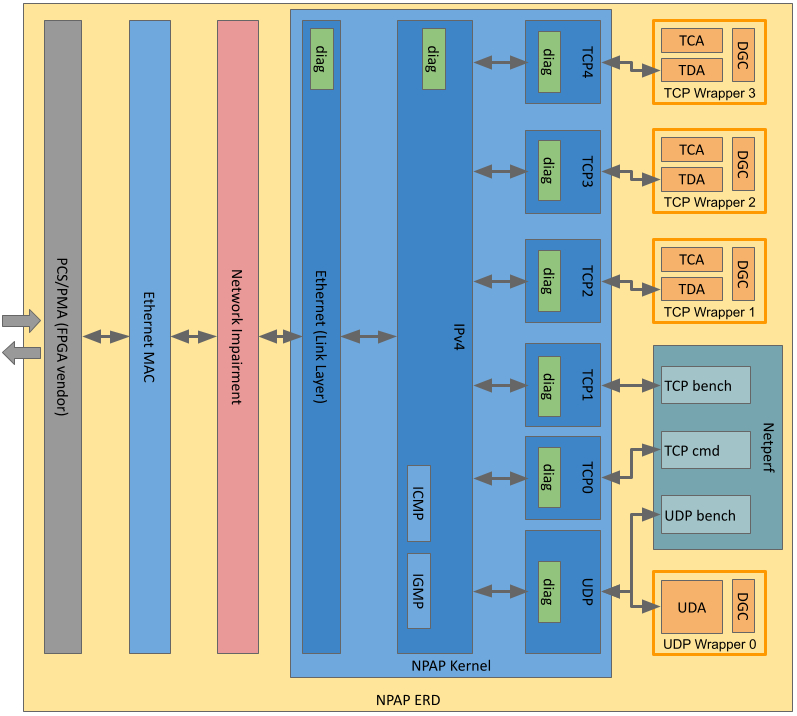
      The German Fraunhofer Heinrich-Hertz-Institute (HHI) has partnered with MLE to market the proven network accelerators “TCP/IPv4 & UDP/IPv4 Network Protocol Accelerator Platform (NPAP)”.  This customizable solution enables high-bandwidth, low-latency communication solutions for FPGA- and ASIC-based systems for 1G / 2.5G / 5G / 10G / 25G / 40G / 50G / 100G / 400G Ethernet links.

      MLE is a licensee of Fraunhofer HHI, and offers a range of technology services, sublicenses and business models compatible with customer’s ASIC or FPGA project settings, world-wide.

      If you are interested in optimizing your Linux based system for best performance with NPAP, we do suggest to read this technical publication from Bruno Leitao, IBM: “Tuning 10Gb network cards on Linux“.

      Edit Template

      Core Benefits

      • Accelerate CPUs by offloading TCP/UDP/IPv4 processing into programmable logic (“Offloading”)
      • Increase network throughput and reduce transport latency
      • Bring full TCP/UDP/IPv4 connectivity to FPGAs even if no CPU available (“Full Acceleration”)
      • Complete and customizable turn-key solutions and IP cores based on the TCP/UDP/IPv4 stack from the Fraunhofer HHI
      • All MAC / Ethernet / IPv4 / UDP / TCP processing is implemented in HDL code, synthesizable to modern FPGAs and ASIC
      • User applications can either be implemented in FPGA logic or in software via application-specific interfaces to CPUs

      Key Features

      •  Interface to 1 / 2.5 / 5 / 10 / 25 / 40 / 50 / 100 / 200 / 400 Gigabit Ethernet
      • Full-duplex with 128 bit wide bidirectional datapath
      • Full line rate of 70 Gbps, or more, per instance in FPGA
      • Full line rate of over 100 Gbps per instance in ASIC
      • Low one-way latency NPAP-to-NPAP (600 nanoseconds for 100 Bytes)
      • Network diagnostics functions (optional)
      • TCP session priority management (optional)
      • Transport Layer Security (TLS) (optional)
      • Time-Sensitive Networking (TSN) (optional)
      • Network Impairment Generators (optional)

      Applications

      • High-Speed connectivity for distributed systems and Systems-of-Systems
      • Scale-out datacenter connectivity
      • Reliable, long-range chip-to-chip connectivity with backpressure
      • FPGA-based SmartNICs
      • High-Bandwidth Security with FPGA-based Smart Data Diodes
      • In-Network Compute Acceleration (INCA)
      • Hardware-only implementation of TCP/IPv4 in FPGA
      • PCIe Long Range Extension
      • Networked storage, such as iSCSI or NVMe/TCP
      • Test & Measurement connectivity
      • Automotive backbone connectivity based on open standards
      • High-speed, low-latency camera interfaces
      • Video-over-IP for 3G / 6G / 12G transports
      • Bring full TCP/UDP/IPv4 connectivity to FPGAs
      • High-speed sensor data acquisition: stream data out of FPGAs into Network-Attached Storage (NAS)
      • High-speed robotics control and machine-to-machine: Stream data from servers via FPGA into actuators
      • Hyper-converged computational storage acceleration for “over-Fabric” NVMe/TCP
      • Deterministic low-latency, high-bandwidth, secure alternative to lwIP or Linux on embedded CPU

      Supported FPGA Cards

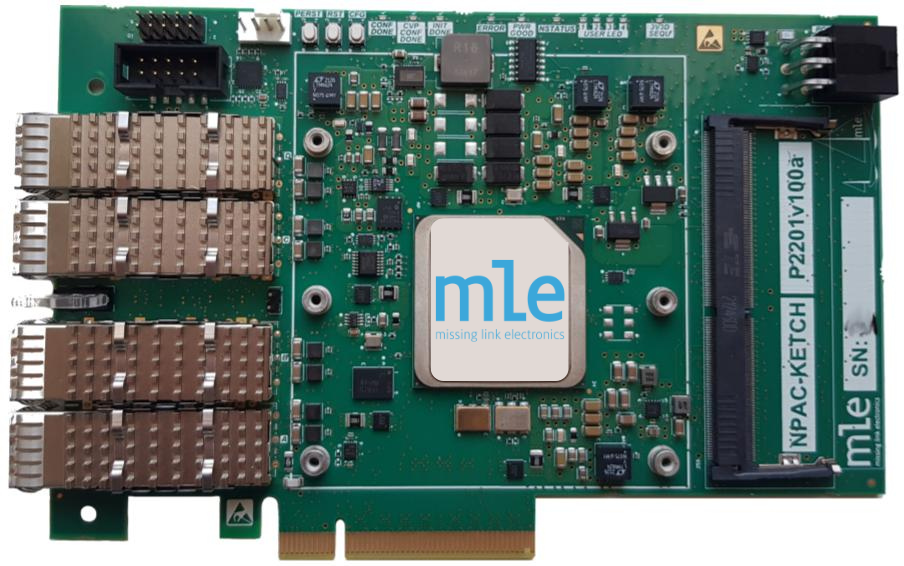
      MLE NPAC-Ketch SmartNIC Card
      • Targeted to Intel Stratix 10 GX 400 (see Eval Guide)
      • Netperf and TCP-/UDP-Loopback example instances
      • 4x SFP+ for 4x 10 GigE via Twinax or Fibre
      • Supports Quartus design flow with High-Level Synthesis design option
      • Runs on MLE NPAC-40G Cost-Optimized SmartNIC
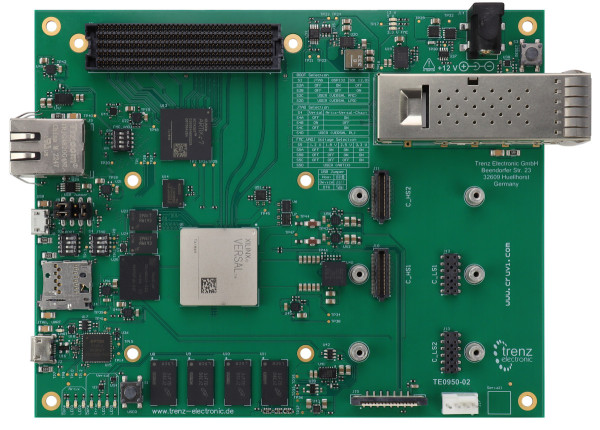
      AMD Versal™ AI Edge Evalboard from Trenz
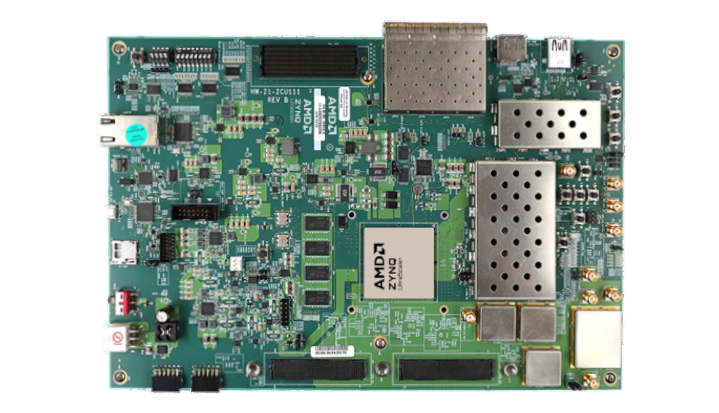
      AMD/Xilinx ZCU111 Zynq Ultrascale+ RFSoC Development Kit - FPGA TCP/UDP/IP Network Accelerator
      • Targeted to Xilinx Zynq Ultrascale+ RFSoC ZU28EG (see Eval Guide)
      • Quad-Core ARM A53MP runs Xilinx PetaLinux
      • Netperf and TCP-/UDP-Loopback example instances
      • SFP28 for 25 GigE via Twinax or Fibre
      • Supports Vivado design flow with High-Level Synthesis design option
      • Runs on Xilinx ZCU111 Development Kit
      AMD/XIlinx ZCU102
      • Targeted to Xilinx Zynq Ultrascale+ MPSoC ZU9EG (see Eval Guide)
      • Quad-Core ARM Cortex-A53 runs Xilinx PetaLinux
      • Netperf and TCP-/UDP-Loopback example instances
      • 4x SFP+ for 10/25 GigE via Twinax or Fibre
      • Supports Vivado design flow with High-Level Synthesis design option
      • Runs on AMD Zynq UltraScale+ MPSoC ZCU102 Evaluation Kit

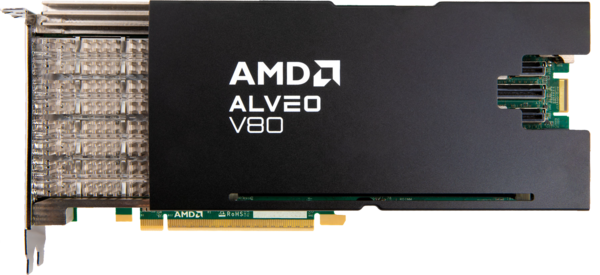
      • Targeted to AMD/Xilinx Versal FPGA (see Eval Guide)
      • Netperf and TCP-/UDP-Loopback example instances
      • QSFP56 for 4x 10/25/40/50 GigE via Twinax or Fibre
      • Supports Vivado design flow with High-Level Synthesis design option
      • Runs on Alveo V80 Compute Accelerator Card complemented by AMD OpenNIC FPGA Shell and device drivers
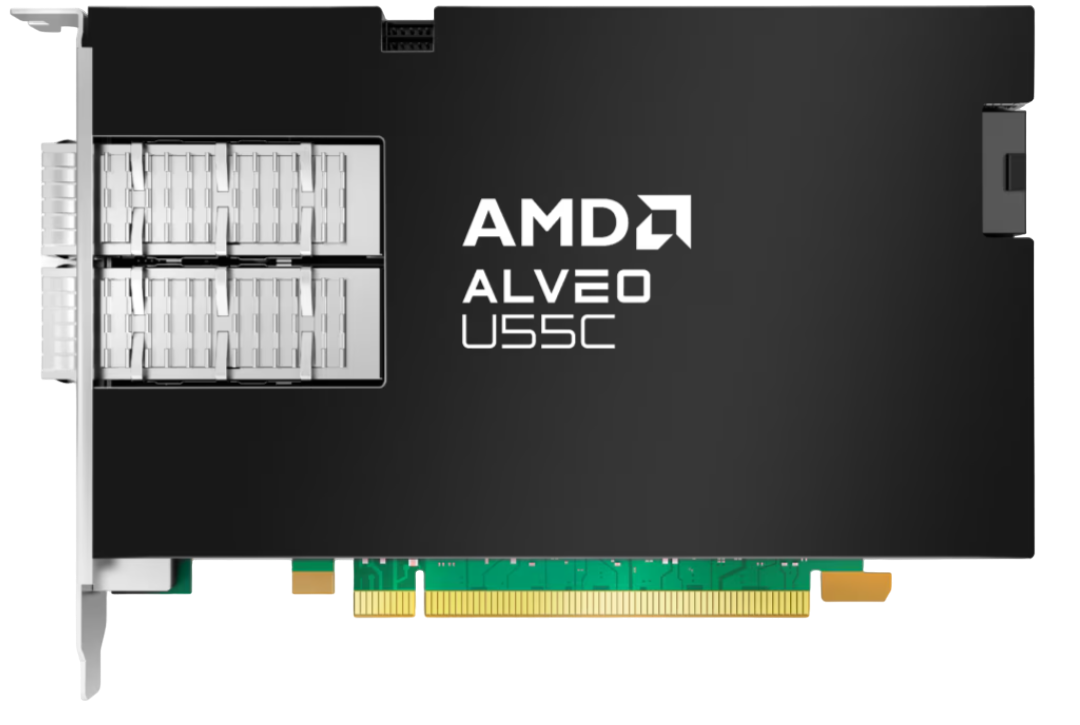
      AMD/Xilinx Alveo U55C High Performance Compute Card
      • Targeted to AMD/Xilinx Virtex UltraScale+ FPGA (see Eval Guide)
      • Netperf and TCP-/UDP-Loopback example instances
      • QSFP28 for 2x 100 GigE via Twinax or Fibre
      • Supports Vivado design flow with High-Level Synthesis design option
      • Runs on Alveo U55C High Performance Compute Card complemented by AMD OpenNIC FPGA Shell and device drivers
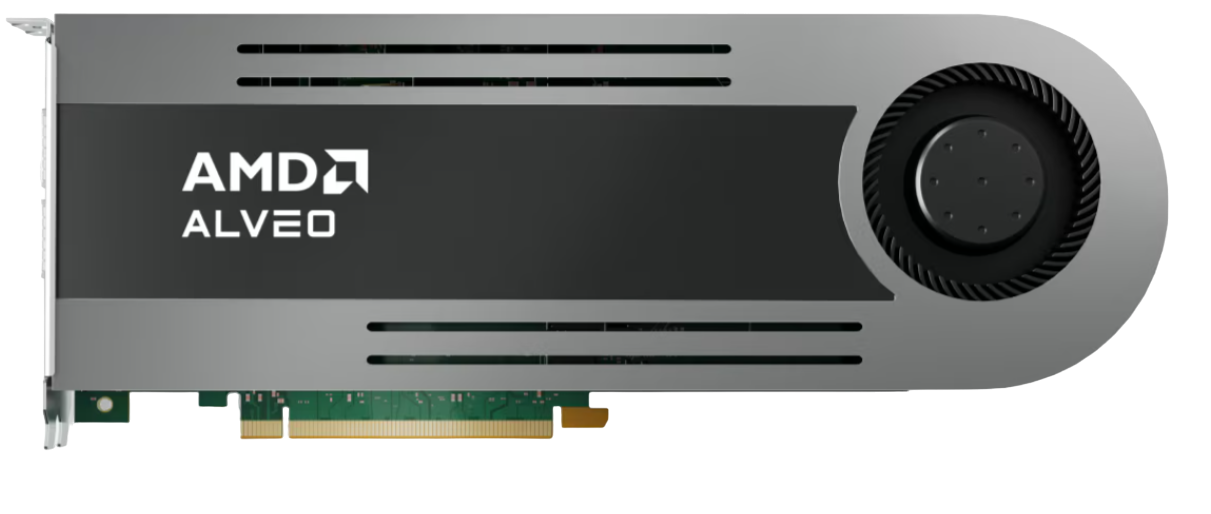
      AMD/Xilinx Alveo U200 Data Center Accelerator Card
      • Targeted to AMD/Xilinx UltraScale+ FPGA (see Eval Guide)
      • Netperf and TCP-/UDP-Loopback example instances
      • QSFP28 for 4x 25 GigE via Twinax or Fibre
      • Supports Vivado design flow with High-Level Synthesis design option
      • Runs on Alveo U200 complemented by AMD OpenNIC FPGA Shell and device drivers
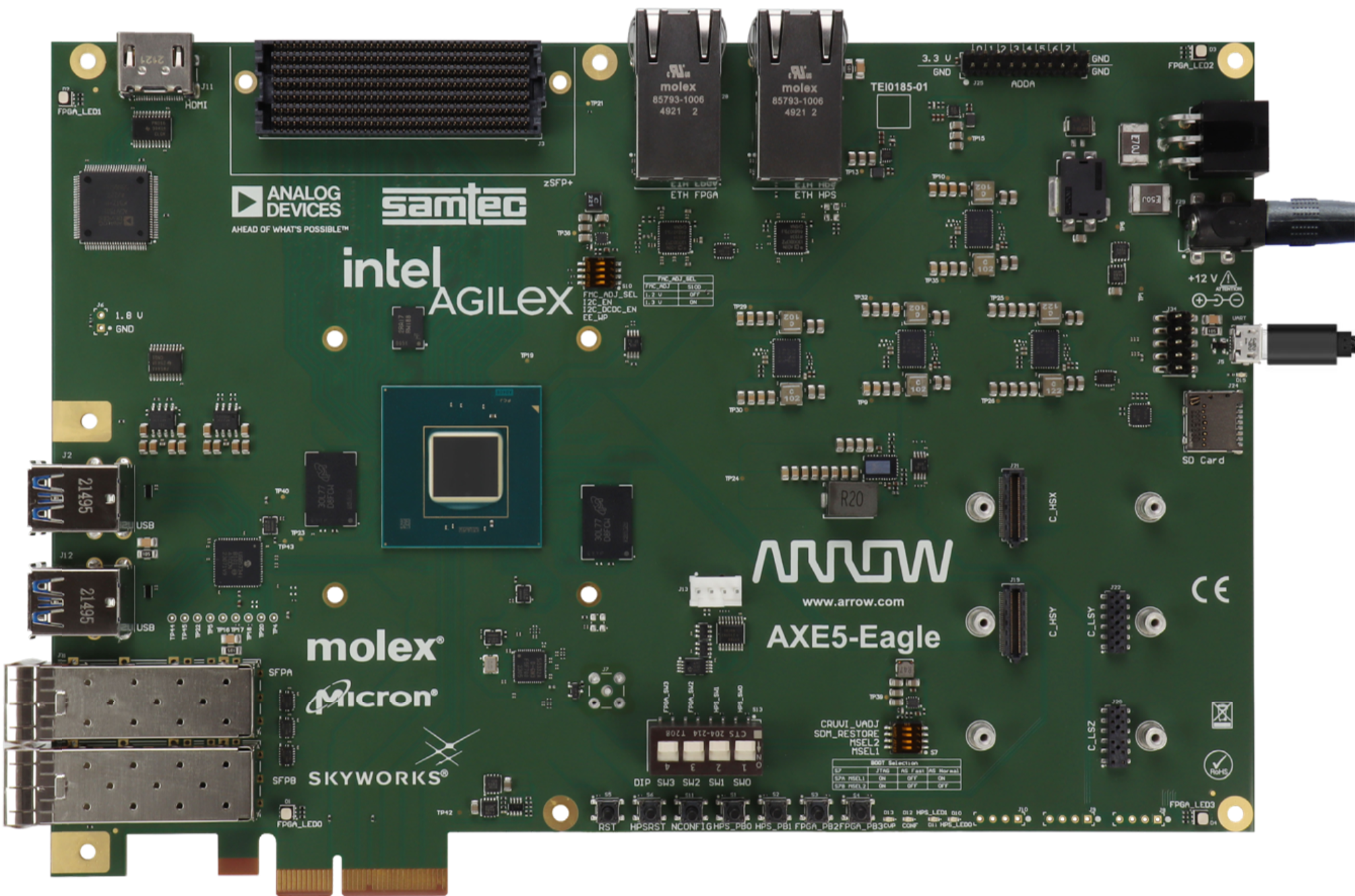
      Arrow AXE5 Eagle Board_top
      • Targeted to Altera Agilex A5E 043B Series FPGA (see Eval Guide)
      • Netperf and TCP-/UDP-Loopback example instances
      • 2x SFP+ for 10 GigE
      • Supports Quartus design flow with High-Level Synthesis design option
      • Runs on Arrow AXE5-Eagle Development Kit
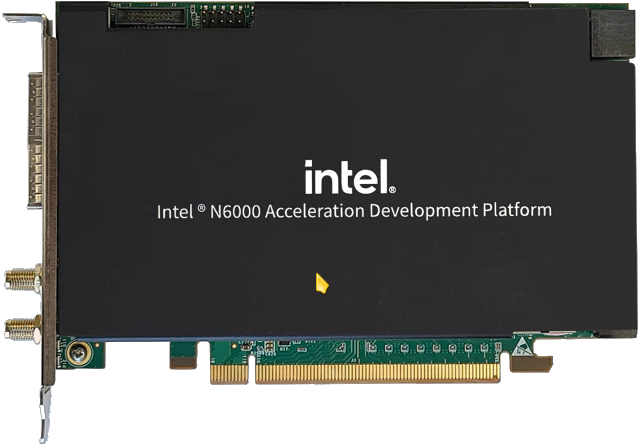
      Intel FPGA SmartNIC N6000-PL Platform
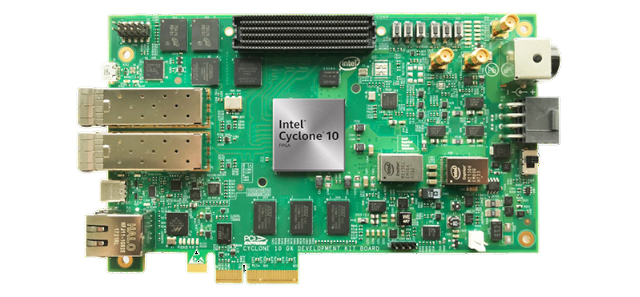
      Intel Cyclone 10 GX Development Kit
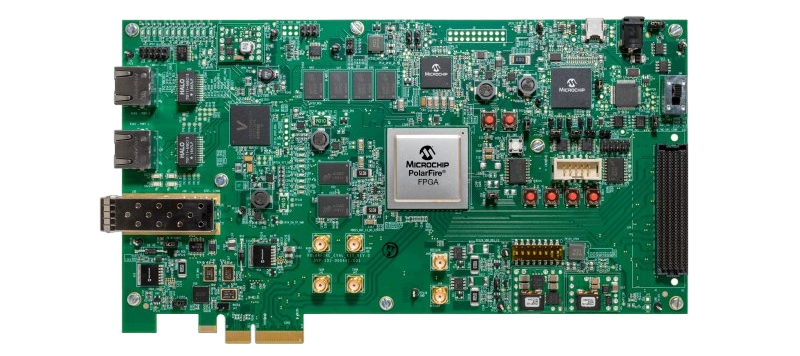
      Microsemi PolarFire MPF300-EVAL-KIT
      • Targeted to Microsemi PolarFire (see Eval Guide)
      • Netperf and TCP-/UDP-Loopback example instances
      • SFP+ for 10 GigE via Twinax or Fibre
      • Supports Libero design flow with High-Level Synthesis design option
      • Runs on Microsemi PolarFire MPF300-EVAL-KIT

      Pricing

      MLE’s network accelerators – Network Protocol Accelerator Platform (NPAP) – is available as a combination of Intellectual Property (IP) Cores, reference designs, and design integration services:

      Product NameDeliverablesExample Pricing
      Network Processing DeviceIntegrated processing device solution, built on top of leading FPGA technology, encapsulating one or more Network Protocol Accelerators for Multi-Gigabit Ethernet.

      Based on NRE and unit volume Inquire

      Intellectual Property (IP) CoresSingle-Project or Multi-Project Use; ASIC or FPGA; Modular and application-specific IP cores, and example design projects; delivered as encrypted netlists or RTL.starting at $78,000.-
      (depends on FPGA device and line rate, please inquire)
      Evaluation Reference Design (ERD)Available upon request as FPGA design project, with optional customizations (different target device, different transceivers, etc)free-of-charge
      Application-specific R&D ServicesAdvanced network protocol acceleration R&D services with access to acceleration experts from Fraunhofer HHI and/or MLE.$1,880.- per engineering day (or fixed price project fee)
      Edit Template

      Documentation

      Encrypted Network Acceleration Solutions (ENAS)

      TCP-TLS 1.3 for Secure 10/25/50 GigE

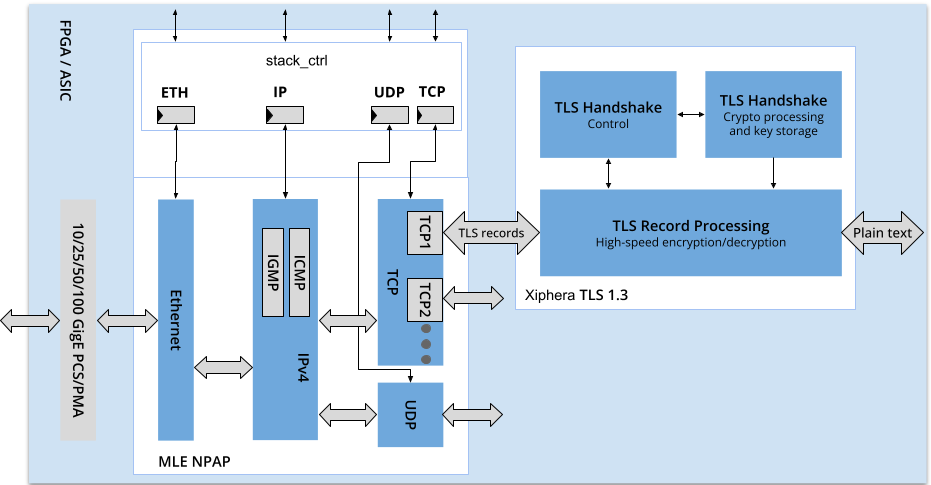
      ENAS are joint solutions of MLE’s TCP/IPv4 Network Protocol Accelerator Platform (NPAP) and Xiphera’s Transport Layer Security (TLS) 1.3 to ensure secure and reliable connection between devices over LAN and WAN. It implements Transport Layer Security, a cryptographic protocol that provides end-to-end data security, on top of the Transmission Control Protocol (TCP) layer.

      Frequently Asked Questions

      NPAP is integrated with the FPGA vendors PCS/PMA layer and thus is compatible with other IEEE compliant Ethernet Network Interface Cards (NIC) for 1 GigE, 10 GigE, 25 GigE, 40 GigE, 50 GigE, 100 GigE, and 400 GigE. Please refer to the FPGA device vendors documentation of the subsystem for further information.

      NPAP implements all networking functions required by IETF RFC 1122 and thus is interoprable with software stacks from Microsoft Windows, Open-Source Linux (3.x or newer) as well as Mellanox/libvma or SolarFlare OpenOnload. Please refer to the NPAP Datasheet for more information.

      Yes, typically, we configure and instantiate NPAP with BRAMs for the Rx/Tx buffers. For applications where NPAP transmits data to a server we suggest 128K Bytes per TCP session (i.e. TCP port instance) to accomodate the (slower) processing of the software TCP stack running on the Recipient. Please refer to the NPAP Datasheet for more information.

      Here is the metric to determine TCP buffer sizes for NPAP (keep in mind, that TCP buffers are placed on both ends: Tx side and Rx side):

      Buffer size (in bits) = Bandwidth (in bits-per-second) * RTT (in seconds)

      RTT is the Round-Trip Time which is the time for the Sender to transmit the data plus the time-of-flight for the data, plus the time it takes the Recipient to check for packet correctness (CRC), plus the time for the Recipient to send out the ACK, plus the time-of-flight for the ACK, plus the time it takes the Sender to process the ACK and release the buffer.

      For example:

      1. If the recipient is NPAP in a direct connection then we can assume ACK times less than 20 microseconds, i.e. buffer sizes shall be 200k bits. Means in this case a 32 kBytes on-chip BlockRAM per TCP session will be sufficient.
      2. If the recipient is software then RTT can be much longer, mostly due to the longer processing times in the OS on the recipient side. For a modern Linux we can assume RTT of 100 microseconds, or longer (see here [1] or run a ‘ping localhost’ on your machine). Means buffer sizes shall be around 1M bits, or the 128K Bytes of BRAM we typically instantiate.

      Fraunhofer HHI

      Founded in 1949, the German Fraunhofer-Gesellschaft undertakes applied research of direct utility to private and public enterprise and of wide benefit to society. With a workforce of over 23,000, the Fraunhofer-Gesellschaft is Europe’s biggest organization for applied research, and currently operates a total of 67 institutes and research units. The organization’s core task is to carry out research of practical utility in close cooperation with its customers from industry and the public sector.

      Fraunhofer HHI was founded in 1928 as “Heinrich-Hertz-Institut für Schwingungsforschung“ and joined in 2003 the Fraunhofer-Gesellschaft as the “Fraunhofer Institute for Telecommunications, Heinrich-Hertz-Institut„. Today it is the leading research institute for networking and telecommunications technology, “Driving the Gigabit Society” .